.png)
The Soul of Wool: Why True Luxury Tailoring Matters
- maisonfidelis24
- Feb 17
- 2 min read

Updated: 1 day ago
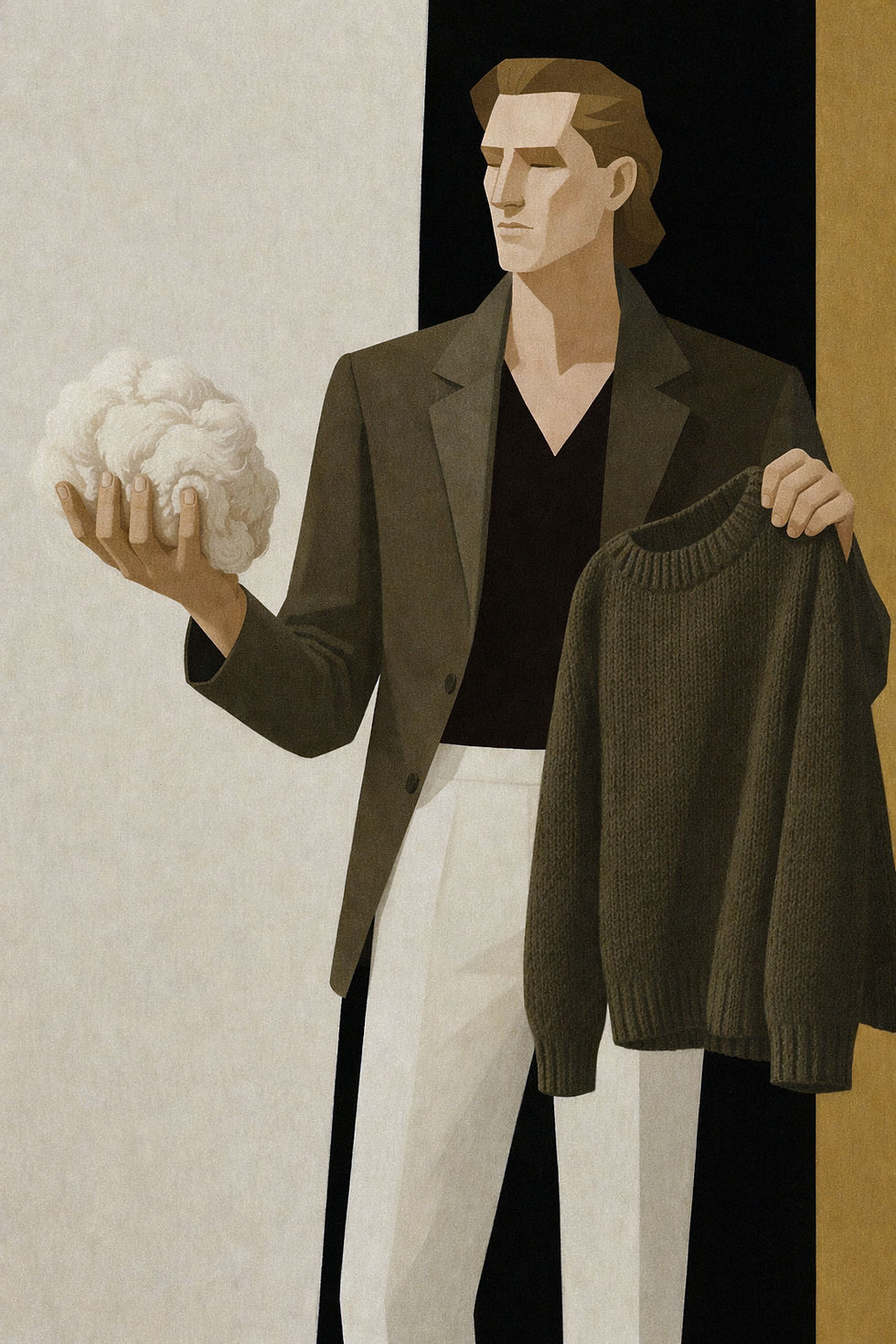
I am writing this because quality has become a term of convenience, used to mask a process that actually destroys the inherent integrity of the object. We often speak of a garment having a soul, which sounds like poetic abstraction, but it is a technical reality rooted in the engineering of the fiber itself. There is a troubling trend in the industry that most brands avoid discussing, they sell you a 100% Wool jumper and present its machine,washability as a triumph, yet in my workshop, we recognize this for what it is, the plasticisation of wool. To understand the friction here, you must look at the fiber under a lens, where a single strand is covered in microscopic scales, a natural architecture that allows the wool to breathe, repel moisture, and maintain an antibacterial pH. In a more resolved era, you didn’t wash a wool jumper, you simply hung it by an open window, allowing the lanolin and the scales to look after the garment instinctively. The mass market "fixes" the tendency of these scales to lock together in a machine through a process called Hercosett 125, it is a two,step act of chemical vandalism where the wool is doused in chlorine to burn the scales away, then coated in a synthetic resin. The result is a wool,synthetic hybrid that holds static and traps odors, a chemically stabilized facade rather than a natural miracle. A common myth suggests that plastic coating creates softness, but in reality, it is used to hide the scratchy nature of inferior, short,staple fibers. At Maison Fidelis, we refuse these treated yarns, choosing instead the finest, longest,staple raw wool where softness is a byproduct of quality, not chemistry. This ensures tactile honesty and a biological logic where the wool remains a living material. If a garment says machine washable, its integrity has been compromised, as true luxury requires a respect that the disposable market finds inconvenient. We do not make pieces for those who treat their wardrobe like a load of towels, we make them for those who value raw, structural truth. It is time to come back to the source.
Your Tailor


Comments